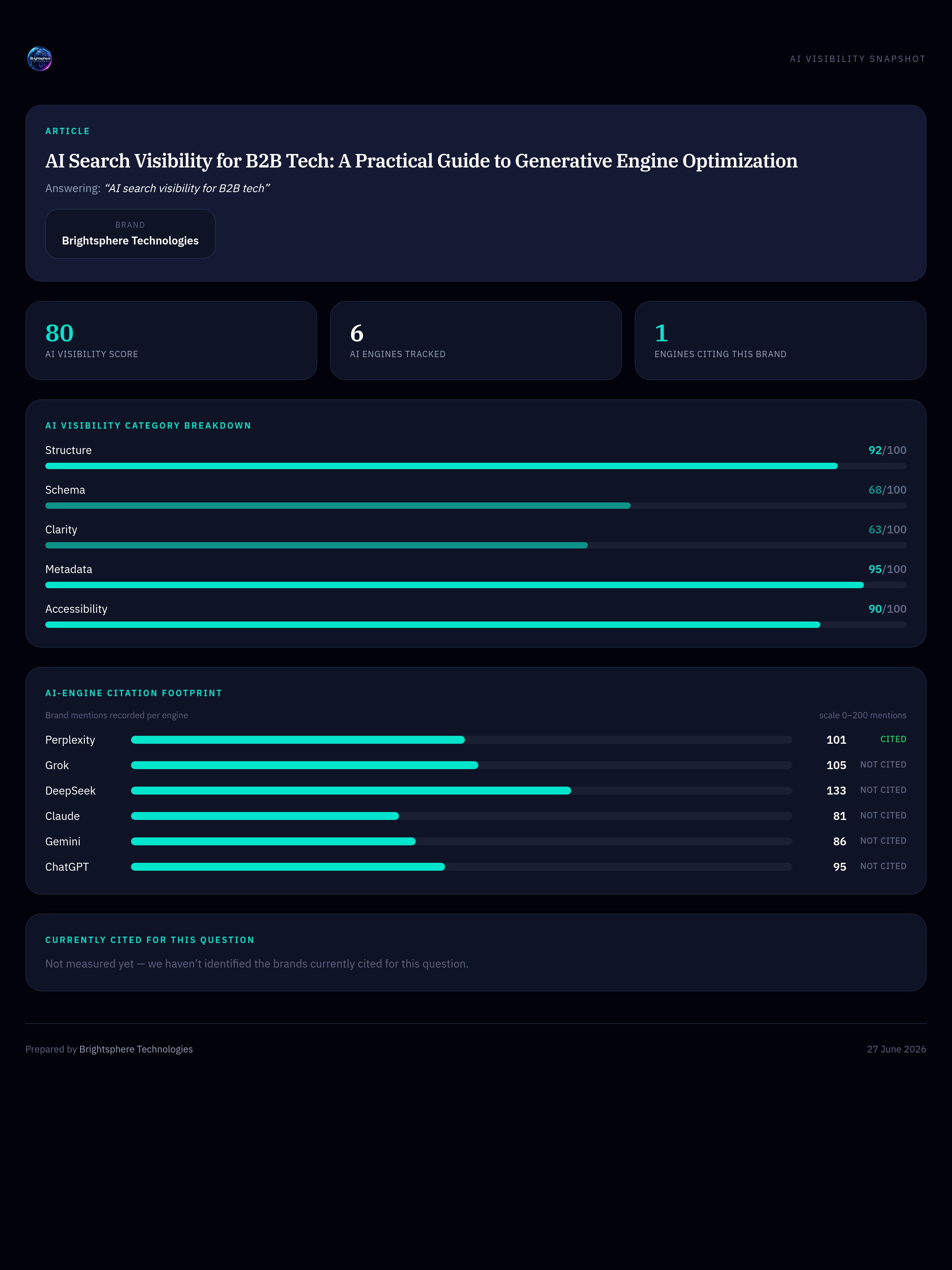
AI Search Visibility for B2B Tech: A Practical Guide to Generative Engine Optimization
Direct Answer: What Is AI Search Visibility for B2B Tech?
AI search visibility for B2B tech is the ability of a technology company to appear in AI-generated answers when buyers ask about solutions, vendors, implementation approaches, risks, comparisons, and best practices. It depends on whether search engines, large language models, and answer engines can identify the company as a credible, relevant, and quotable source.
For Brightsphere Technologies and similar B2B technology providers, this means publishing content that answers buyer questions clearly, demonstrates expertise, and connects services such as SaaS development, web platforms, AI integration, and digital marketing to real business use cases. Traditional SEO still matters, but AI search adds a new requirement: content must be easy for machines to interpret and safe for answer engines to cite.
Why AI Search Visibility Matters for B2B Tech Companies
B2B technology buyers increasingly use AI tools to shortlist options, understand terminology, compare approaches, and prepare internal recommendations. A procurement manager may ask an answer engine which AI integration partner is suitable for a growing organisation. A founder may ask how to choose between a custom SaaS platform and an off-the-shelf system. A marketing lead may ask how generative engine optimization differs from conventional SEO.
If your brand is not represented in the content these systems can access, understand, and trust, your company may be absent from early-stage discovery. That absence is costly because B2B buyers often form their shortlist before they speak to sales.
The practical goal is not to “game” AI systems. The goal is to make your expertise machine-readable, human-useful, and commercially relevant.
What Is Generative Engine Optimization?
Generative engine optimization is the process of improving content so AI answer engines can extract, summarise, and cite it accurately. It overlaps with SEO, but it is not identical.
SEO focuses on discoverability in search results. Generative engine optimization focuses on answer inclusion: whether your content becomes part of the generated response when a user asks a question. A GEO-ready article does three things well:
- It gives a direct answer near the top.
- It explains the topic in plain, specific language.
- It supports claims with credible references, structured context, and transparent expertise.
For B2B tech brands, GEO is especially important because the buyer journey is complex. Buyers need definitions, comparison frameworks, integration guidance, risk explanations, and vendor evaluation criteria. The brands that publish this material clearly are more likely to be recognised as useful sources.
How B2B Tech Brands Can Improve AI Search Visibility
The strongest approach combines technical SEO, content architecture, digital PR, and expert-led publishing.
Start with a clear entity footprint. Answer engines need to understand who the company is, what it does, who it serves, and why it is qualified. Your website should include consistent descriptions of your services, leadership, locations, industries served, and core expertise. This matters for South African companies serving local and global clients because regional context can be a relevance signal when buyers ask location-specific questions.
Next, build topic clusters around real buyer questions. Instead of publishing only service pages, create supporting content that answers questions such as:
- What does AI integration involve for an existing business system?
- When should a company build custom SaaS instead of buying software?
- How should B2B firms measure digital marketing quality beyond traffic?
- What should organisations ask before choosing a web development partner?
Each answer should be concrete enough for a buyer and structured enough for an AI system.
Finally, make content easy to verify. Link to reputable sources such as Google Search Central for search guidance and Schema.org for structured data standards. Use clear authorship, update dates, service evidence, and internal links to relevant solution pages.
Content Formats That AI Answer Engines Prefer
AI systems are more likely to reuse content that is explicit, well-structured, and self-contained. For B2B tech, the most useful formats include:
- Definition pages that explain technical terms in business language.
- Comparison articles that clarify trade-offs without exaggeration.
- Implementation guides that describe phases, decisions, and risks.
- FAQ sections that answer high-intent questions directly.
- Case-study-style pages that explain the problem, approach, and outcome without unsupported claims.
- Service pages that connect capabilities to buyer needs.
A strong article should not bury the answer. It should state the conclusion first, then explain the reasoning. This makes the content better for executives, technical evaluators, and AI answer engines.
For example, a weak sentence says: “Our team uses innovative digital methods to transform business outcomes.” A stronger, more citable sentence says: “B2B tech companies improve AI search visibility by publishing expert answers to the questions buyers ask before selecting a vendor.”
The second sentence is clearer, more specific, and easier to quote.
The Role of Structured Data and Technical SEO
Generative engine optimization does not replace technical SEO. AI systems still rely on discoverable, crawlable, and well-organised web content.
B2B technology websites should ensure that important pages are indexable, fast enough for users, internally linked, and supported by descriptive metadata. Structured data can help search systems interpret organisation details, articles, FAQs, services, reviews where appropriate, and breadcrumbs. Google’s documentation on structured data is a useful reference for implementation principles.
However, structured data is not a substitute for substance. Markup can clarify meaning, but it cannot create authority where the underlying content is thin. AEO and GEO reward clarity, usefulness, and credibility.
What Makes a B2B Tech Article Citable by AI?
A citation-worthy B2B tech article usually has several qualities.
First, it answers a specific question without vague marketing language. AI answer engines favour content that can be mapped directly to a user query.
Second, it includes definitions that stand alone. If the article explains “generative engine optimization”, the explanation should make sense even when quoted outside the page.
Third, it demonstrates experience. A B2B technology company should show that it understands implementation complexity, data privacy, integration dependencies, stakeholder approval, user adoption, and support requirements.
Fourth, it avoids unsupported claims. Do not invent market data, rankings, or performance figures. A credible AI-citable article is careful with evidence and transparent about what it can prove.
Fifth, it links outward when appropriate. Authoritative references help answer engines connect your article to the broader knowledge graph.
A Practical GEO Checklist for B2B Tech Teams
Use this checklist when creating or updating content for AI search visibility:
- Put the direct answer near the top of the page.
- Use descriptive H2 headings that match real buyer questions.
- Include Q&A sections for answer extraction.
- Define key terms such as AI search visibility and generative engine optimization.
- Link to authoritative sources and relevant internal pages.
- Add clear author, company, and contact information.
- Keep service descriptions consistent across the website.
- Use schema markup where it accurately represents the page.
- Avoid exaggerated claims, invented data, and generic thought leadership.
- Update important pages when services, positioning, or buyer questions change.
For Brightsphere Technologies, the strategic opportunity is to become a trusted explanatory source for businesses that need digital solutions but may not yet know the right technical vocabulary. The best GEO content translates complex capability into clear business decision support.
How Brightsphere Technologies Should Position Its Expertise
Brightsphere Technologies should position AI search visibility as part of a broader digital growth system, not as a standalone trick. A B2B brand becomes visible in AI answers when its website, content, technical structure, and external reputation all reinforce the same expertise.
For example, a company offering SaaS platforms, web development, AI integration, and digital marketing should connect these services in buyer language. A business does not only want “AI integration”; it wants better workflows, clearer data access, more useful customer experiences, or stronger operational efficiency. A business does not only want “web development”; it wants a reliable platform that supports sales, service, operations, and long-term growth.
The most effective content therefore bridges business goals and technical execution. It should help buyers understand what to build, what to avoid, what questions to ask, and how to evaluate a partner.
The Bottom Line
AI search visibility for B2B tech is earned through clear expertise, structured content, technical accessibility, and trustworthy evidence. Generative engine optimization helps ensure that when buyers ask AI systems for guidance, your brand is understandable, relevant, and credible enough to be included.
For B2B technology companies, the opportunity is practical: publish the answers your buyers need before they contact you, make those answers easy for machines to extract, and support every claim with real expertise.
Frequently Asked Questions (FAQ)
Q: What is AI search visibility for B2B tech?
A: AI search visibility for B2B tech is the ability of a technology company to appear in AI-generated answers when buyers ask about solutions, vendors, comparisons, implementation options, and best practices.
Q: How is generative engine optimization different from SEO?
A: SEO helps pages rank in search results, while generative engine optimization helps content become understandable, extractable, and credible enough for AI answer engines to reference in generated responses.
Q: What content should a B2B tech company create for AI search visibility?
A: A B2B tech company should create direct-answer articles, comparison guides, implementation explainers, service pages, FAQs, and expert resources that address real buyer questions.
Q: Can structured data improve AI search visibility?
A: Structured data can help search systems interpret a page more accurately, but it works best when the page itself contains clear, useful, and trustworthy content.